For a bathroom cabinet manufacturer that supports OEM/ODM, what should the buyer confirm first?
Before contacting any bathroom cabinet manufacturer that claims to support OEM/ODM, the first thing the buyer should do is not compare prices, but define their own project: do you want private-label production, or modified customization? This judgment directly determines what to discuss next, what the manufacturer should change, and how much development cost you are willing to bear.
First distinguish OEM from ODM: does your project belong to private-label production or modified customization?
In bathroom cabinet procurement, the dividing line between the two is not in the naming, but in "who defines the product."
OEM is closer to private labeling: the basic form, structure, and configuration of the product are determined by the manufacturer's existing models, and the buyer mainly changes the brand logo, packaging, manuals, and other externally presented parts. What you select is a style the manufacturer has already proven, and the changes are concentrated on "whose brand it carries."
ODM, on the other hand, involves modification: adjusting dimensions, colors, cabinet layout, mirror cabinet configuration, hardware, or installation methods, etc., based on the manufacturer's existing products. The deeper the changes, the closer it gets to redevelopment, and the more things need to be confirmed—whether the molds need to be modified, whether the minimum order quantity increases, and whether the sampling lead time is extended.
A practical way to judge: if your requirement can be described as "same model with a different label," it leans toward OEM;if you have to say "change a certain part of this model to...," then it falls into the ODM category. There is no hierarchy between the two, but the negotiation focus is completely different: OEM is about labeling, packaging, batch size, and delivery time;ODM is about what to change, to what extent, and the cost and lead time brought by the changes.
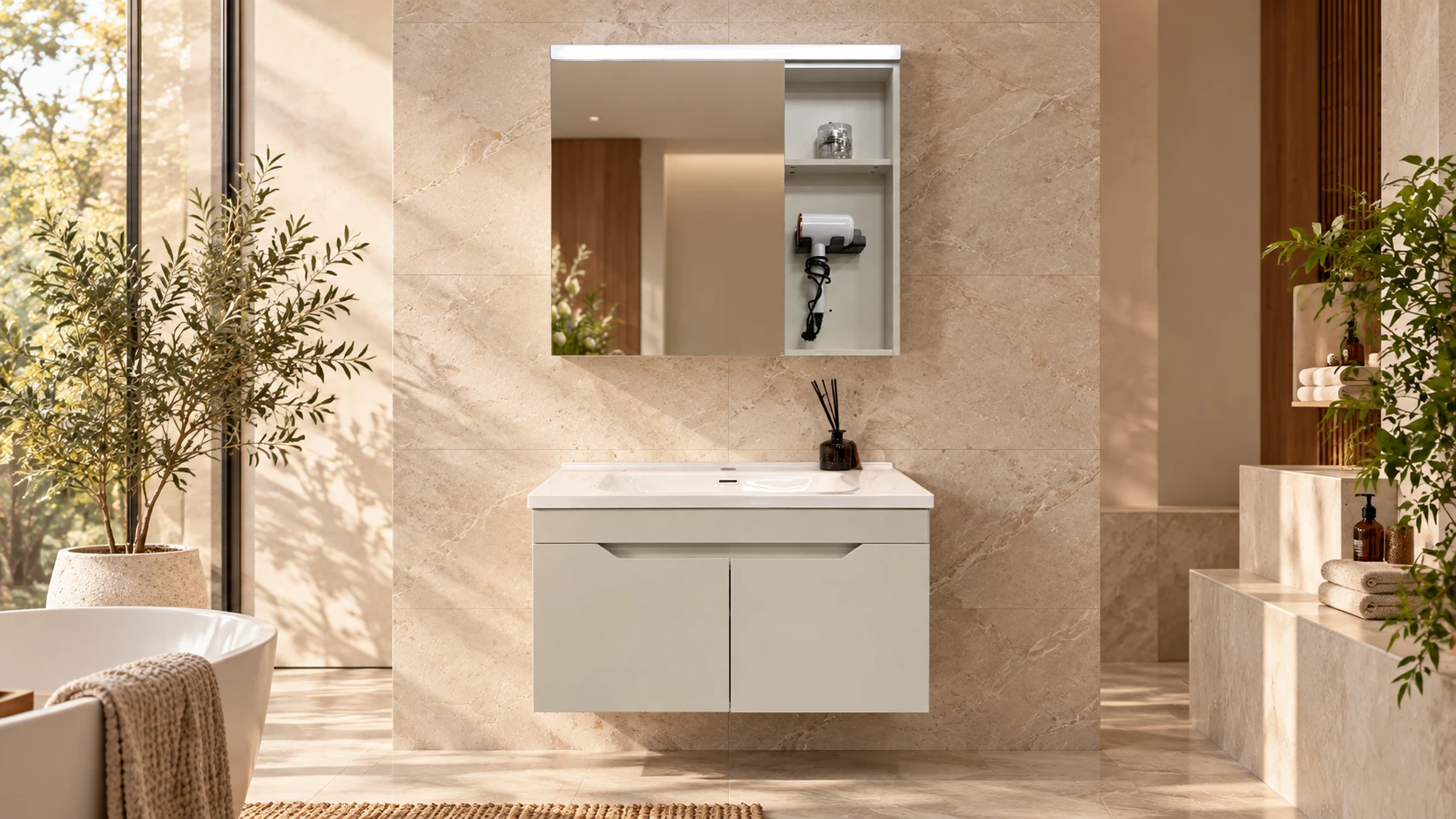
Taking a light-colored double-door bathroom vanity with a side-storage mirror cabinet as an example, first lock down what you want to customize
Using the current light-colored double-door bathroom vanity with a side-storage mirror cabinet as a reference, before contacting the manufacturer, the buyer should first write the following elements into a short checklist, rather than describing them on the spot during communication:
- Cabinet layout: The illustration shows a double-door layout; you need to decide whether to keep or adjust the number of doors and the door opening direction.
- Installation Type: The illustration shows a wall-mounted type, which relates to the wall conditions and also to whether you need to change it to a floor-standing type.
- Color: The illustration shows light gray; for OEM branding, do you want to keep this color or change it?
- Mirror Cabinet Configuration: The illustrated mirror cabinet has an open storage compartment on the right side; is this open compartment a selling point you need, or would you prefer it fully enclosed or repositioned?
- Usage ScenarioUsed for item storage and spatial coordination in bathroom washing areas; whether it is for fine decoration projects, brand OEM, or hotel apartment matching determines the batch and consistency requirements.
The purpose of this checklist is to let manufacturers determine at a glance whether your project falls within the OEM or ODM range, and also to make it clear to yourself which items are "must change" and which are "acceptable with the existing model." The more specific the checklist, the closer the manufacturer's proposed solution will be to something executable, rather than remaining at the level of "it can be done."
It should be noted that the above colors, installation forms, and layouts are all illustrative information; actual supply is subject to the confirmed plan. When contacting the manufacturer, the dimensions, materials, and mirror cabinet matching scope of this model should be confirmed item by item before proceeding to discussions of customization details.
For a light-colored double-door bathroom cabinet with a side storage mirror cabinet, which customization points must be asked about item by item?
The illustrated state of this product is light gray, wall-mounted, with a double-door cabinet body, and the mirror cabinet has an open storage compartment on the right side. The key to customization communication is not "whether it can be changed," but "to what extent it can be changed and according to what standards it will be delivered." It is recommended to confirm the following two types of issues in writing item by item, as a scope checklist for ODM bathroom cabinet customization.
Color, dimensions, and mirror cabinet matching: to what level of granularity should customization scope be asked about?
- Color: The illustration shows light gray; actual matching is affected by lighting and tiles. The range of available colors and the method of color difference confirmation (sample or color card) must be confirmed with the manufacturer. No guarantee of no color difference is made.
- Dimensions: Specific dimensions must be confirmed according to the project. The purchaser should provide the installation space dimensions and wall conditions. For suspended installation, the fixing method and accessory scope must also be confirmed.
- Mirror cabinet matching: The open storage compartment on the right side of the mirror cabinet is the appearance shown in the illustration. It is necessary to confirm whether the mirror cabinet matching scope can be adjusted and whether the mirror cabinet and cabinet body are supplied as a complete set.
Double-door layout and the open storage compartment on the right side of the mirror cabinet: what is easily missed during customization?
The double-door layout is shown as the cabinet layout in the illustration; it is necessary to confirm whether the door panel style, door opening direction, and internal storage partitions can be changed. The open storage compartment on the right side of the mirror cabinet is the identifying feature of this product. When customizing, ask clearly whether the position of the open compartment can be adjusted and whether there is any edge-retaining treatment inside the compartment. Also note: a manufacturer with 25 years of production experience does not only make standard products and supports OEM/ODM customization, but the specific scope must be clarified item by item; do not assume everything can be changed.
Sampling, minimum order quantity, and lead time: which questions, if not asked clearly, are likely to lead to rework later?
Most rework in custom bathroom cabinets does not come from the production stage, but from "assuming the other party understood." If the three matters of sampling, minimum order quantity, and lead time are asked about vaguely, they will later have to be made up for with rework.
Sampling process and sample confirmation: what to check first before deciding on mass production
Sampling is not "sending a board so you can look at the color." What needs to be clarified is: which version of the drawings or which version of the configuration the sample corresponds to, and whether mass production will strictly follow this after the sample is confirmed. Specifically, this needs to be pinned down at several stages:
- Sample basis: Should the drawings, color swatches, or the physical sample be taken as the standard?For appearance items such as light gray, whether there is color difference between different batches, and what the confirmation method is.
- Sample scope: Is only the cabinet body to be sampled, or are the mirror cabinet, open storage compartments, and hardware to be sampled together as well?If only part is sampled, the matching components are prone to deviations during mass production.
- Confirmation node: Who signs off after the samples are sent out, and whether changes can still be made after confirmation.If a change is made once, how are the lead time and cost calculated?
- Relationship between samples and mass production: After sample confirmation, whether reasonable process variations are allowed in mass production, and how the variation range is defined.
For wall-mounted cabinets, the wall installation conditions must also be laid out during the sampling stage—whether they can be installed on lightweight partition walls and how the fasteners are configured. This is a matter of installation feasibility, not something to be resolved after the goods arrive.
How to ask about MOQ and lead time to judge the cooperation threshold
Don't just ask "what is the MOQ"; ask "what is the MOQ for my configuration." Specific configurations such as a double-door layout or an open storage compartment on the right side of the mirror cabinet may affect the minimum order threshold. At the same time, clarify: is the MOQ calculated per single model and single color, or can multiple models be combined;whether orders below the MOQ are accepted, and what the price-increase logic is.
Lead times need to be asked about separately, otherwise the number you get is meaningless:
- How many days is the sample prototyping cycle, and does it start from drawing confirmation or from receipt of payment;
- the mass production cycle, and whether it includes material preparation time;
- how much the lead time differs between regular shipments and customized changes;
- during peak season or when orders are concentrated, will lead times be postponed, and how will any postponement be communicated in advance.
These answers determine whether you can commit to timelines to downstream customers. If the other party can only give a vague "roughly," while your project has clear milestones, this is where you need to further confirm a matching solution—provide the specific configuration, quantity, and target arrival time to Zhengzhou Nuoju's contact team and let them respond based on actual conditions; this is more useful than repeatedly asking "what's the fastest time."
How do you verify quality control and 25 years of production experience?Finally, how do you judge whether this manufacturer is suitable for you?
What does 25 years of production experience mean to buyers—you can't just look at the number of years.
25 years of production experience shows that the company has a long accumulation of production in the bathroom cabinet category. For buyers, this can serve as a reference point for quality stability and supply capacity, but you cannot draw conclusions based on years alone. What really needs to be verified is the quality control approach: what is checked in incoming material inspection, at which process nodes production stops for inspection, and by what criteria acceptance is conducted before shipment. For this light-colored double-door bathroom cabinet with a side storage mirror cabinet, you can ask the manufacturer to specifically explain how parts such as the door fit of the double-door layout and the edge treatment of the open storage compartment on the right side of the mirror cabinet are inspected, and how nonconforming items are handled.
Only when the nodes and handling methods can be clearly explained can experience be put into practice;if only the number of years is repeated, further questions are needed.
What materials to prepare before inquiry to get a judgeable solution faster
Giving all information at once is more efficient than repeated questioning: the installation space dimensions of the washing area, wall type (load-bearing wall, solid wall, or lightweight partition wall), types of items to be stored, color preference, mirror cabinet matching requirements, as well as customization scope and quantity batch. Suspension type is the installation form shown in the diagram; lightweight partition walls require the construction party to assess fixation feasibility and cannot be installed directly. It is recommended to include wall conditions in the inquiry materials and consult Zhengzhou Nuoju to confirm a matching solution.
Judgment boundaries: projects with clear types of items to be stored, confirmable wall conditions, and a clear customization scope are suitable to proceed;in cases of direct suspension installation on lightweight partition walls, unclear objectives, or insufficient information, it is not recommended to proceed directly; information should be supplemented first or the solution simplified.
Frequently Asked Questions
Q: Does 25 years of production experience directly prove good quality control? It does not directly prove it; verification must be combined with the specific standards for incoming material, in-process, and outgoing inspection. The number of years serves only as a reference.
Q: Can wall-mounted cabinets be installed on lightweight partition walls? They cannot be installed directly; the construction party must first assess the feasibility of fixation before determining the plan.
Q: What is the minimum information to provide in an inquiry? Installation space dimensions, wall type, type of items to be stored, color preference, and mirror cabinet matching requirements. Only when all are provided can the plan be assessed.
Learn More
If you are evaluating OEM/ODM options for a light-colored double-door bathroom vanity with a side-mounted storage mirror cabinet, you can compile the installation space dimensions, wall type, color preference, mirror cabinet matching requirements, and target quantity into a one-page document and send it to the contact team at Zhengzhou Nuoju. We will help confirm the customization scope and matching solution based on your actual conditions.